Genotype Readers in Python: BCF, PGEN, and BGEN at One Thread
Reader benchmarks are easy to overstate: one tool counts records while another materializes genotypes, or a parallel result is placed next to a serial one. Here every headline result uses one thread and produces the same dense matrix, with the same row order, sample order, dtype, and missing-value convention.
The result is mixed, and more useful for it. polars-bio is fastest on the BCF
and PGEN workloads. On BGEN dosage, the independent bgen package is 3.9%
faster at one thread; polars-bio is 1.54× faster than snputils. polars-bio has
zero mismatches against the independent oracle in every workload tested.
Fairness contract
All inputs come from the phased, biallelic 1000 Genomes GRCh38 chromosome 22 callset and contain the same 2,548 samples.
| Workload | Variants | Values | Required output |
|---|---|---|---|
| BCF GT dosage | 25,000 | 63,700,000 | row-major int8, missing = −1 |
| PGEN hardcall | 993,881 | 2,532,408,788 | row-major int8, missing = −9 |
| PGEN dosage | 993,881 | 2,532,408,788 | row-major float32, missing = NaN |
| BGEN dosage | 993,881 | 2,532,408,788 | row-major float32, missing = NaN |
| BGEN probabilities | 25,000 | 254,800,000 | row-major float32 GP tensor |
The BCF comparison uses the 25,000-variant slice so record-at-a-time Python readers, including pysam, remain practical. PGEN and BGEN dosage use the full chromosome; the larger BGEN probability tensor uses the same slice. Results are compared only within a workload, never across rows of this table.
Each reader runs in a fresh process. Imports and thread-pool initialization are excluded; opening the source, discovering the schema, decoding, converting, and producing the final contiguous matrix are timed. Filesystem cache state is warm, reader order rotates, and reported times are medians of three runs. DataFusion, Polars, Rayon, OpenMP, BLAS, Accelerate, and NumExpr are capped at one thread for the headline tables.
Each library uses its appropriate dense-output path. In particular, polars-bio
uses read_pgen_matrix and read_bgen_matrix, matching the NumPy arrays
returned by the reference readers rather than charging only polars-bio for a
DataFrame-to-matrix conversion.
Correctness before speed
The checks are exact: no epsilon and no rounded summaries. Complete matrices are compared element by element after verifying positions and sample order.
| Workload | Oracle | polars-bio mismatches | Other readers vs oracle |
|---|---|---|---|
| BCF dosage, 63.7M cells | pysam | 0 | cyvcf2 0; snputils 0 |
| PGEN hardcall, 2.53B cells | pgenlib | 0 | snputils 0 |
| PGEN dosage, 2.53B cells | pgenlib | 0 | snputils 0 |
| BGEN dosage, 2.53B cells | bgen |
0 | snputils 126,259,603 |
| BGEN probabilities, 254.8M cells | bgen |
0 | snputils 0 |
The PGEN verifier also corrupts one cell and confirms that the comparison detects it. snputils' PGEN result is not an independent oracle—it wraps pgenlib—so polars-bio versus pgenlib is the meaningful check there.
On full-cohort BGEN dosage, snputils differs from bgen by at most
1.18e-7; the discrepancy is tiny but not zero. polars-bio matches all
2,532,408,788 values bit for bit. On the 25,000-variant probability tensor,
all three readers agree exactly.
Results
BCF dosage
| Reader | Median time |
|---|---|
| polars-bio | 0.171 s |
| snputils | 0.862 s |
| cyvcf2 | 1.951 s |
| pysam | 27.675 s |
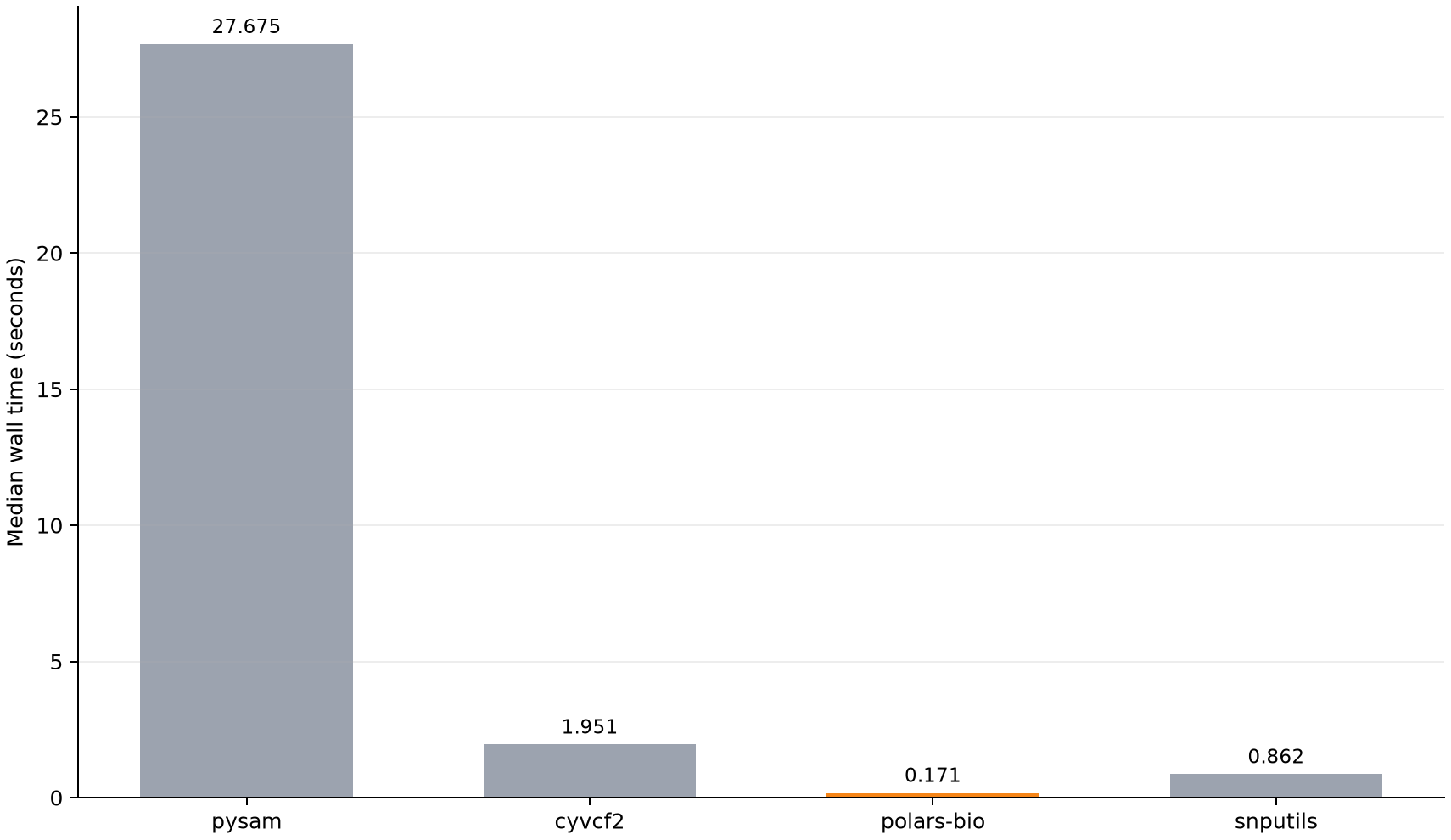
pysam is included here because it supports BCF. It is not shown for PGEN or BGEN because it cannot read those formats; an unsupported cell is not a slow result and cannot be made apples-to-apples.
PGEN hardcalls and dosage
| Reader | Hardcall int8 |
Dosage float32 |
|---|---|---|
| polars-bio | 0.699 s | 1.312 s |
| pgenlib | 0.840 s | 1.879 s |
| snputils | 0.845 s | 2.791 s |
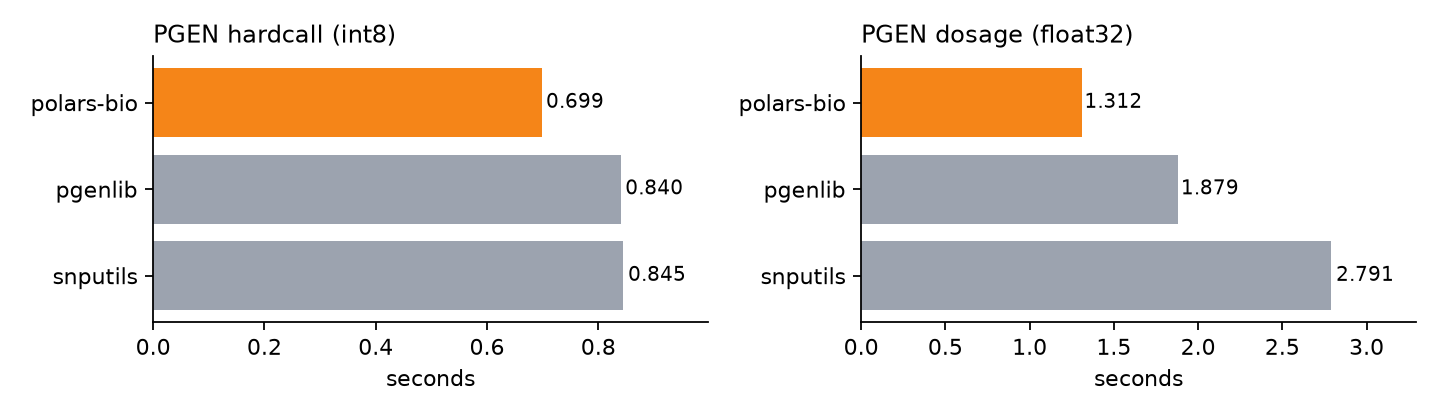
At equal core count, polars-bio is 1.20× faster than pgenlib on hardcalls and 1.43× faster on dosage. pgenlib remains slightly more memory-efficient because it decodes directly into its caller-owned array.
BGEN dosage
| Reader | Median time |
|---|---|
| bgen | 10.979 s |
| polars-bio | 11.404 s |
| snputils | 17.551 s |
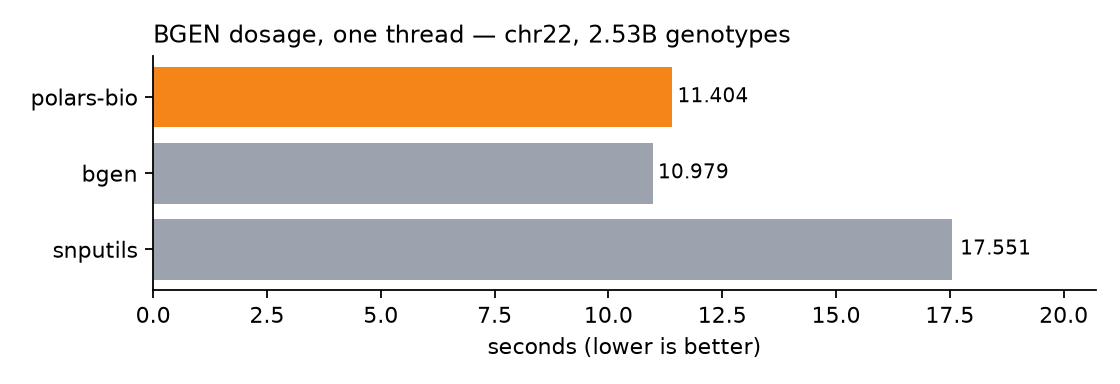
This rerun corrects the earlier claim that polars-bio was fastest on BGEN at
one thread. The bgen package leads by 0.425 s, while polars-bio remains 1.54×
faster than snputils.
polars-bio scalability
The cross-reader tables stay at one thread. Separately, the same full-chromosome polars-bio workloads were run with 1, 2, 4, and 8 partitions:
| Workload | 1 partition | 2 partitions | 4 partitions | 8 partitions | Speedup at 8 |
|---|---|---|---|---|---|
| PGEN hardcall | 0.699 s | 0.434 s | 0.311 s | 0.242 s | 2.89× |
| PGEN dosage | 1.312 s | 0.792 s | 0.513 s | 0.385 s | 3.41× |
| BGEN dosage | 11.404 s | 6.529 s | 3.598 s | 2.071 s | 5.51× |
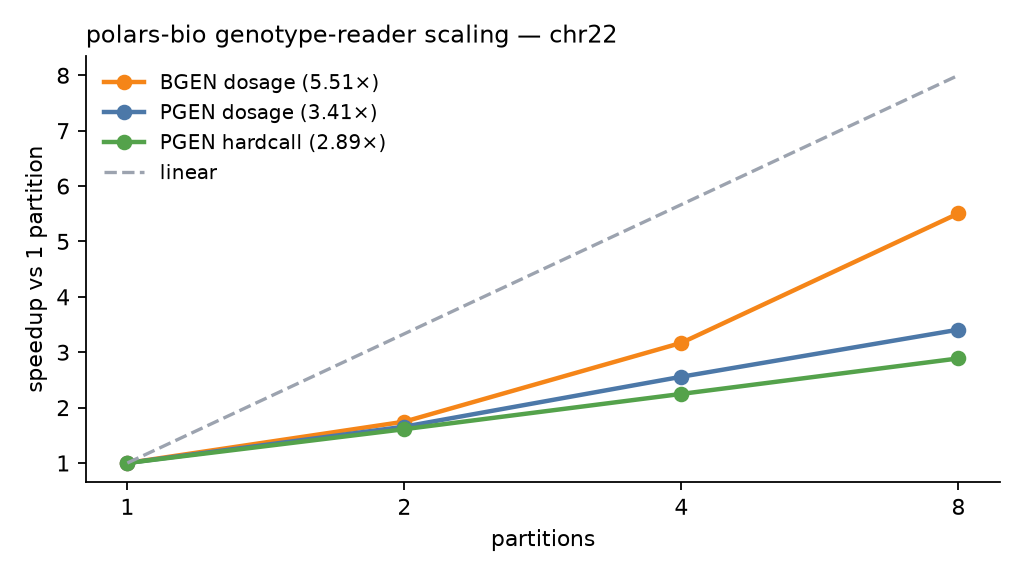
These are within-reader scaling results, not comparisons against the serial reference readers.
Reproduce
These results cover the code shipping as polars-bio 0.34.0, with every formats
crate pinned to the released
datafusion-bio-formats v1.10.0
commit 0d9730c, and the current
snputils benchmark
at 482c6d1.
| Component | Version |
|---|---|
| polars-bio | 0.34.0 |
| snputils | 1.1.1.dev19+g482c6d1df |
pgenlib / bgen / pysam |
0.94.1 / 1.10.0 / 0.24.0 |
| Polars / PyArrow / NumPy | 1.42.1 / 24.0.0 / 2.5.2 |
| Python / host | 3.12.9 / Apple M3 Max, 64 GiB, macOS 15.6 |
polars-bio was built as an optimized native extension:
The runners, fixture construction, raw-result schema, and exact verification
logic are in
bioformats-benchmark:
run_genotype_matrix_benchmarks.py, run_pgen_benchmarks.py, and
run_bgen_benchmarks.py.
The main conclusion is narrower than “one reader wins.” Under equal work and equal core count, polars-bio leads BCF and PGEN, nearly ties the specialized BGEN oracle, and reproduces every oracle value exactly. Keeping those constraints visible is what makes the timings worth comparing.