Performance
Design goals
vepyr targets a 30x+ speedup over the reference Ensembl VEP Perl implementation while maintaining zero mismatches for the supported annotation scope.
Why it's fast
Native Rust engine
The entire annotation pipeline — allele matching, interval tree lookups, consequence prediction, HGVS computation — runs in compiled Rust code. No interpreter overhead touches the hot path.
Apache DataFusion
vepyr uses DataFusion as its query execution substrate. This provides:
- Vectorized execution over Arrow columnar batches
- Predicate pushdown to minimize data scanned
- Parallel partition processing
Streaming architecture
Results are streamed as Arrow RecordBatches rather than materializing full datasets in memory. This keeps memory usage bounded regardless of input VCF size.
Optimized cache format
The Ensembl VEP offline cache ships as Perl Storable / Sereal serialized files. vepyr converts these to a partitioned Parquet cache — columnar, compressed, with sorted row groups, per-chromosome shards, and a page/column index that powers fast point lookups for co-located variants.
COITree interval matching
Transcript overlap queries use COITree (cache-oblivious interval trees), which provide O(n + log(n)) query performance.
Benchmarking
Running a comparison
To benchmark vepyr against Ensembl VEP on the same input. For the full parity setup — downloading the HG002 benchmark VCF, normalizing it, and running the comparison harness — see Testing against Ensembl VEP.
Ensembl VEP (Docker):
time docker run --rm \
  -v /data/vep/homo_sapiens/115_GRCh38:/opt/vep/.vep/homo_sapiens/115_GRCh38:ro \
  -v /work:/work \
  ensemblorg/ensembl-vep:release_115.2 \
  vep \
  --dir /opt/vep/.vep \
  --cache --offline --assembly GRCh38 \
  --input_file /work/input.vcf \
  --output_file /work/output.vcf \
  --vcf --force_overwrite --no_stats \
  --everything
vepyr:
import vepyr
import time

start = time.time()
lf = vepyr.annotate(
    vcf="input.vcf",
    cache_dir="/data/vepyr_cache/parquet/115_GRCh38_ensembl",
    reference_fasta="GRCh38.fa",
)
df = lf.collect()
elapsed = time.time() - start
print(f"{df.height} variants in {elapsed:.1f}s")
Ensembl VEP vs vepyr on one machine
Both tools annotated the same normalized HG002 GRCh38 input with the same
release-116 merged cache, --everything --hgvs and a reference FASTA, writing
plain VCF, on one MacBook Pro (Apple M3 Max, 16 cores, 64 GiB). VEP ran in
its native arm64 Docker image (16 vCPU, 16.5 GiB VM); vepyr 0.7.0 ran on the
host. Whole-process wall time, one run per setting. VEP --fork N runs N
annotation children plus the parent, so the runs are paired by process count:
VEP without --fork against vepyr's default workers=1, --fork 1 against
workers=2, and --fork 8 (nine processes) against workers=8.
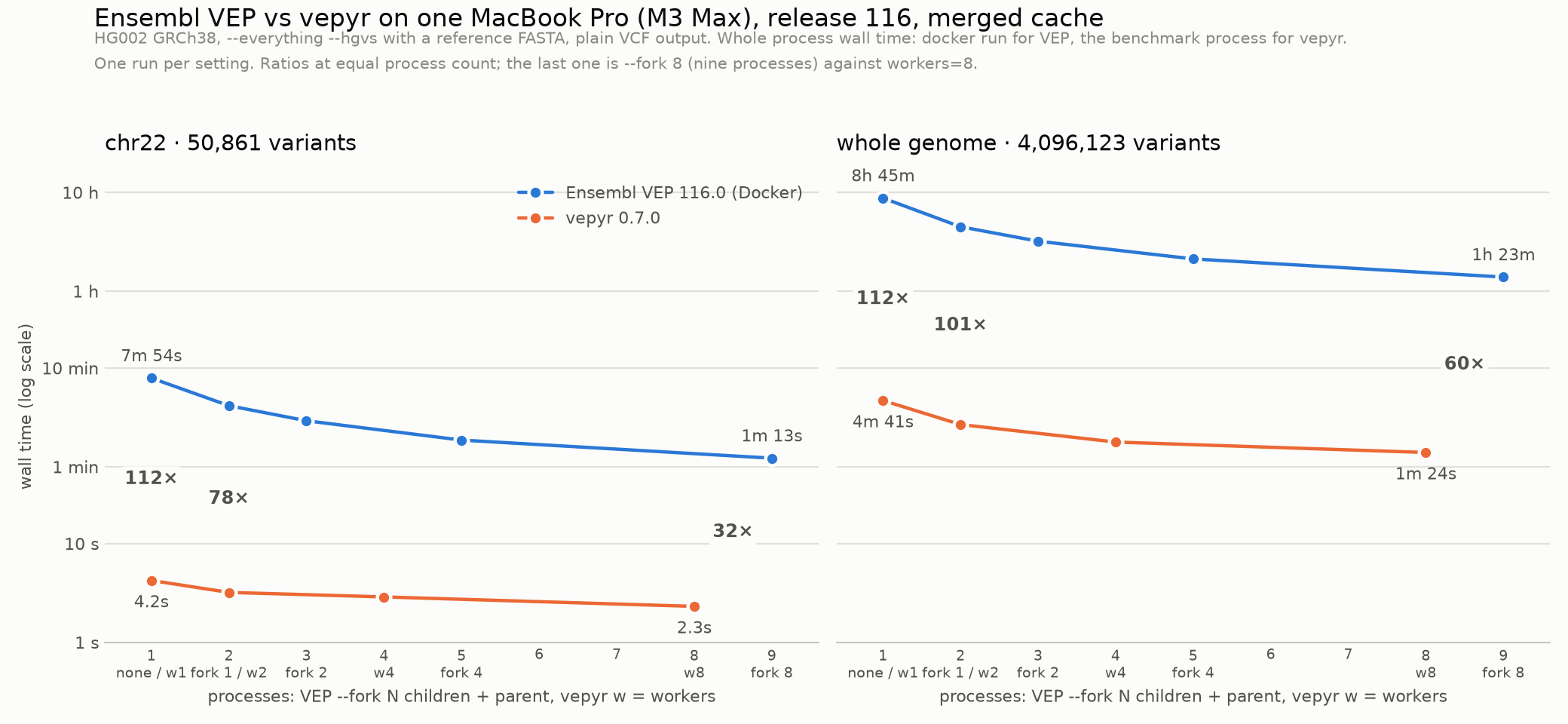
| Input | Ensembl VEP 116.0 | vepyr 0.7.0 | Ratio |
|---|---|---|---|
| chr22, 50,861 variants | no fork, 7:54 | workers=1, 4.2 s |
112× |
--fork 1, 4:09 |
workers=2, 3.2 s |
78× | |
--fork 8, 1:13 |
workers=8, 2.3 s |
32× | |
| whole genome, 4,096,123 variants | no fork, 8:45:41 | workers=1, 4:41 |
112× |
--fork 1, 4:29:09 |
workers=2, 2:40 |
101× | |
--fork 8, 1:23:15 |
workers=8, 1:24 |
60× |
On chr22 the vepyr workers=8 output is CSQ-identical to VEP's serial run on
all 50,861 records; against VEP --fork 8 the only differences are 115
records where VEP's forked run leaves HGNC_ID empty. The full sweeps
(--fork / workers 1, 2, 4, 8), the logs, checksums and the exact commands
are in
performance-tests/README.md.
Region filters
A LazyFrame filter() on chrom, start or end is pushed into the engine
before annotation (see Polars DataFrames).
Measured with e2e-testing/scripts/region_pushdown_parity.py --release 116 on
HG002 contig slices, a FASTA, workers=1, on an Apple Silicon M3 Max (16 cores, 64 GiB). Every
pushed-down frame was identical to the whole-slice frame filtered in Polars.
| Input | Query | Rows | Ensembl | Merged | RefSeq |
|---|---|---|---|---|---|
| chr22, 50,861 variants, indexed | collect() |
50,861 | 2.6 s | 3.2 s | 2.0 s |
chr22:20,000,000-25,000,000 |
5,406 | 0.6 s | 1.3 s | 0.8 s | |
chr22:30,000,000-30,100,000 |
59 | 0.1 s | 0.7 s | 0.5 s | |
chr22:17,000,000-17,500,000 or chr22:40,000,000-40,200,000 |
1,262 | 0.2 s | 1.2 s | 0.8 s | |
chr22:45,000,000- |
10,650 | 0.6 s | 1.1 s | 0.7 s | |
| chr22, unindexed copy | chr22:20,000,000-25,000,000 |
5,406 | 0.6 s | 1.2 s | 0.8 s |
| chr1, 323,430 variants, indexed | collect() |
323,430 | 17.0 s | 22.5 s | 14.9 s |
chr1:20,000,000-25,000,000 |
7,871 | 1.2 s | 2.9 s | 1.7 s | |
chr1:30,000,000-30,100,000 |
275 | 0.6 s | 1.8 s | 1.1 s | |
chr1:17,000,000-17,500,000 or chr1:40,000,000-40,200,000 |
1,718 | 1.0 s | 2.9 s | 1.9 s | |
chr1:200,000,000- |
73,839 | 3.8 s | 6.1 s | 3.4 s | |
| chr1, unindexed copy | chr1:20,000,000-25,000,000 |
7,871 | 1.6 s | 2.4 s | 1.4 s |
Merged and RefSeq ranges pay for one positional count pass over the contig plus a warm-up of the input buffers before the range, which keeps their output byte-identical to a whole-file run. Without an index the whole slice is parsed and filtered before annotation, so small ranges gain less.
Workers on the LazyFrame path
Measured with e2e-testing/scripts/lazyframe_workers_parity.py --release 116 --sweep 1 2 4 8
on HG002 contig slices, a FASTA, on an Apple Silicon M3 Max
(16 cores, 64 GiB). Every frame equalled the workers=1 frame row for row, and
the LazyFrame CSQ column equalled the output_vcf INFO/CSQ at workers=8.
| Input | workers | Ensembl | Merged | RefSeq |
|---|---|---|---|---|
| chr22, 50,284 variants | 1 | 2.5 s | 3.4 s | 2.0 s |
| 2 | 1.8 s | 2.4 s | 1.5 s | |
| 4 | 1.2 s | 1.5 s | 1.0 s | |
| 8 | 0.8 s | 1.1 s | 0.7 s | |
| chr1, 319,349 variants | 1 | 13.5 s | 19.1 s | 13.5 s |
| 2 | 8.6 s | 11.9 s | 8.6 s | |
| 4 | 5.9 s | 8.1 s | 5.8 s | |
| 8 | 3.8 s | 5.5 s | 3.2 s |
Each contig is cut into grid-aligned runs that a pool of workers tasks
annotates concurrently and releases in order.
Tuning
| Parameter | Default | Effect |
|---|---|---|
workers |
1 |
Within-contig annotation pipelines on both output paths; values greater than 1 require a tabix-indexed (bgzip + .tbi/.csi) input VCF. Output is identical to workers=1, row order included. On the command line this is --fork. |
| region filters | – | A LazyFrame filter() on chrom/start/end is pushed into the engine: unselected contigs are skipped and indexed inputs are read by seek (see Polars DataFrames). |
partitions |
1 |
DataFusion partitions during cache build — increase for parallel conversion |